Portrait of Mind - Hurricanes (1995), chapter 11 from The Works
- tinekestorteboom
- 2 days ago
- 2 min read
After the gates, another question emerged.
What does the mind look like? Not the face. Not the personality .But the place where thoughts appear before they become words. I had no image to begin with.
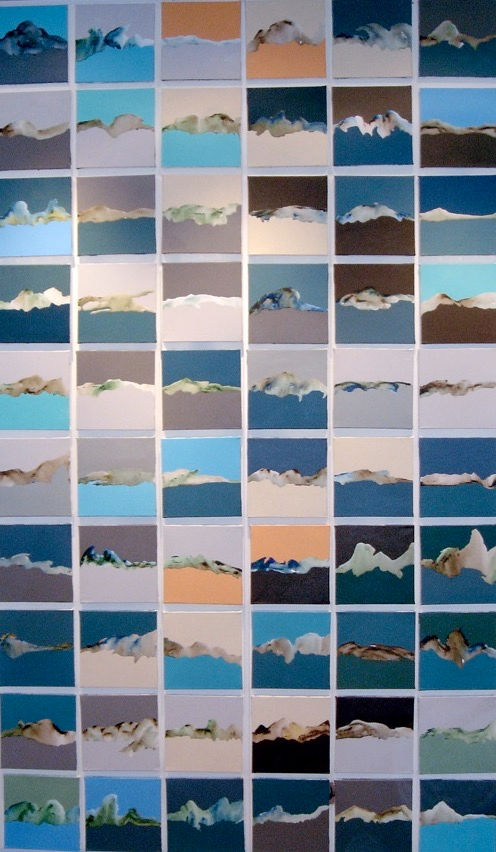
Instead, I started drawing. Dozens of drawings.
Each one explored a slightly different movement. Spirals. Fragments. Floating forms. Small blocks that collided or drifted apart. Some drawings felt quiet others almost turbulent.
They were never meant as preparatory sketches alone.
Each drawing was an investigation in its own right.
Many eventually found homes of their own while others continued growing into larger paintings.
Looking back I recognize that this way of working has remained with me ever since. Not searching for a single image but allowing a series of images to think through a question.
The paintings gradually became less about objects and more about processes.
Thoughts rarely move in straight lines. They return. Circle. Expand. Collapse. Disappear, only to emerge somewhere else. The spiral entered the work almost naturally.
Not as a symbol but as movement itself.
It suggested concentration and expansion at the same time. A thought gathering itself or dissolving into something larger.
Around these movements other forms appeared. Fragments. Floating stones. Small geometric shapes. They seemed to interrupt the flow,or perhaps give it direction.
I never understood them as separate elements. Together they formed a landscape.
Not the landscape outside but the landscape through which consciousness moves.
Looking back,I realize that I was no longer trying to paint what I saw.
I was trying to paint what happens before seeing.
The paintings became portraits not of individuals but of awareness itself.
Perhaps that is why they never settled into fixed compositions.
The mind is never still.
It constantly rearranges itself finding temporary order within continuous movement.
Only years later did I recognize that these paintings marked another quiet shift.
Earlier series had explored space, thresholds and orientation. Now the work entered a territory without architecture. The landscape had moved inward.
And with it painting became less an act of representation than an act of observation.
Not observing the world.
But observing the movement of attention itself.
"The mind is like a monkey, always jumping from branch to branch."
Traditional Buddhist saying
"Can you remain unmoving until the right action arises by itself?"
Inspired by the Daodejing


Comments