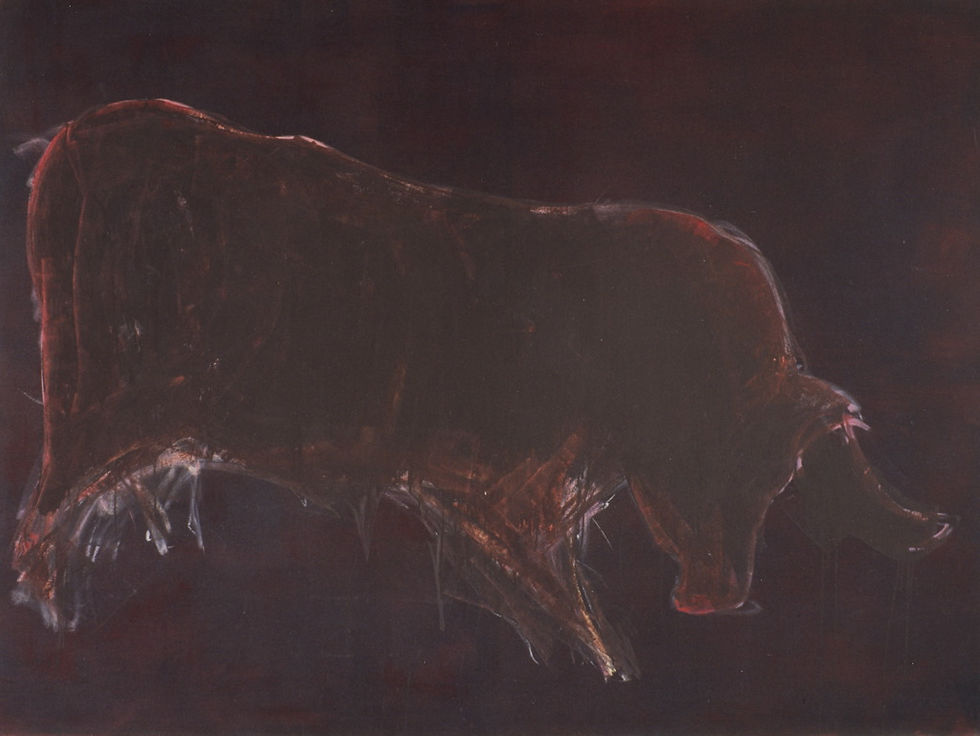
The Bull, the Minotaur and Duende (1996), chapter 12 from The Works
- tinekestorteboom
- 2 days ago
- 2 min read
After the body,another presence entered the work.
The bull.
It did not arrive as an idea. It arrived as a necessity.
As a child I had been fascinated by mythology, especially the story of Theseus and the Minotaur.
The image had never really left me.
Deep inside the labyrinth, there was no treasure waiting.
There was a creature. Half man. Half bull.
For years I had understood the labyrinth as a path toward the center.
Only later did another question emerge.
What if reaching the center is not the end of the journey?
What if something is waiting there?
Not something outside ourselves, but something we have forgotten. Something instinctive.
Something ancient. Something alive.
Around the same time I encountered another bull.
Not in Greek mythology, but in Zen Buddhism.
The Ten Oxherding Pictures by the Chinese Zen master Kakuan describe the gradual search for the ox, its taming, its disappearance, and finally the return to ordinary life.
At first I saw these images simply as a beautiful spiritual story.
Only years later did I recognize that the ox and the Minotaur were not opposites.
Both point toward an encounter with a force that cannot be controlled.
One must not kill it. Nor simply obey it. One has to meet it.
The paintings changed. The human figure slowly dissolved into muscular forms,
mass, horns, movement. The bull was never merely an animal.
It became a way of painting energy itself. Not violence. Not aggression. But vitality. Presence.
The untamed force that lives beneath thought.
Only much later did I discover another word that belonged to these paintings:
duende.
Federico García Lorca describes duende as something that does not descend from heaven.
It rises from the earth. It cannot be learned, copied, or possessed.
It only appears when something essential is at stake.
When life itself enters the work.
Reading Lorca, I recognized something I had already been painting.
The bull was not a symbol. It was an encounter with that living force. A force that refuses certainty.
That asks for courage rather than control.
Looking back,
I realize these paintings marked another shift. Earlier series searched for silence,
space, awareness, orientation. The bull demanded something else. Embodiment.
The courage to remain present without escaping into ideas.
Perhaps that is why the bull continues to appear throughout history.
From the caves of Lascaux, to the frescoes of Knossos, to Picasso, to the Spanish corrida.
Not because it represents power, but because it confronts us with life before it becomes language.
The labyrinth had taught me that the center exists.
The gate had taught me that it cannot be forced.
The mind had shown me how endlessly thought moves.
The bull revealed something different.
That beneath all thought, beneath all searching, there is a living force
that simply asks to be met.
After the bull, the work became quieter.
"All that has dark sounds has duende."
Federico García Lorca
"The wild geese do not intend to cast their reflection; the water has no mind to receive their image."
Zen saying

Comments